City of Duluth Stormwater Management Plan
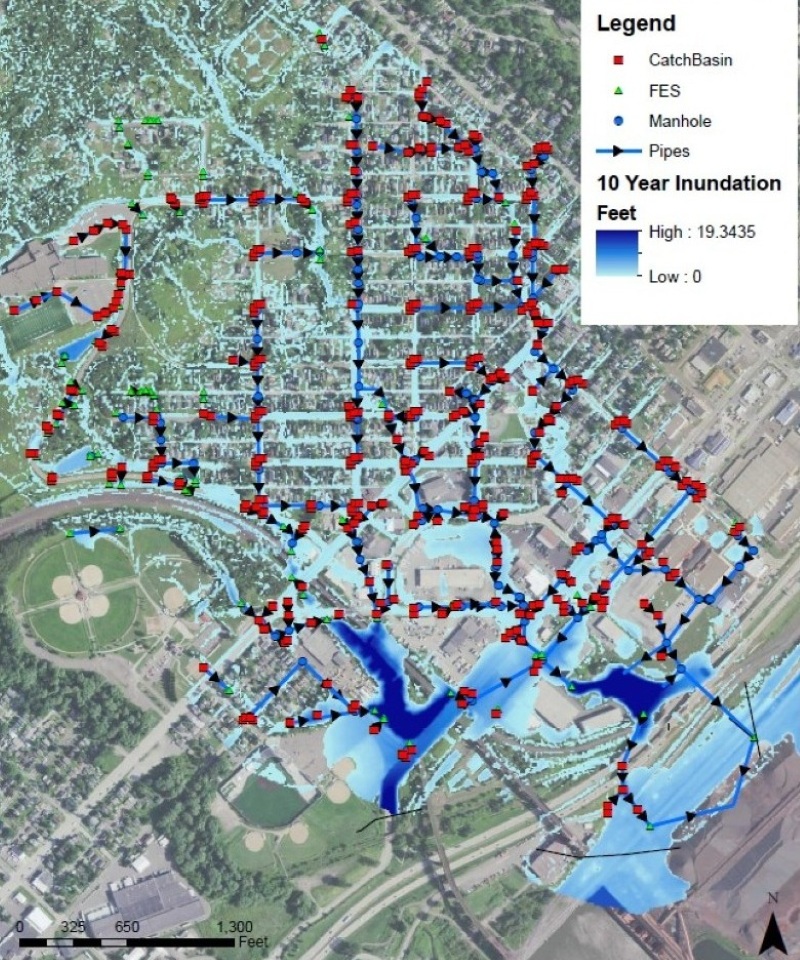
Figure 1 Map
10-Year Existing Conditions Figure 1 Map provided by SEH.
Project Status:
Completed
Project Overview:
In 2022, the City of Duluth began a project to develop a Stormwater Management Plan, to identify drainage characteristics in the city. This also included tasks like prioritizing watersheds where resilience improvements are needed with the impacts of climate change in mind and performing a detailed study of the 32nd Ave W Creek Watershed to identify areas of specific vulnerability, including a public workshop to gather community input on resilience needs. These combined efforts resulted in the Stormwater Management Plan, Watershed Priority Matrix and 32nd Ave W Creek Watershed Study. All these resultant outcomes are critical to planning for stormwater resilience improvements throughout Duluth and adapting to increases in flooding and precipitation caused by climate change. The city consulted Short Elliot Hendrickson Inc. to complete the work.
The vast history of the City of Duluth is reflected in its distinctive natural and urban landscape qualities. The city stretches along the shores of Lake Superior, with a unique geology and topography, altitudes range from 605 to 1,485 feet above sea level; rich in water resources with over 240 miles of streams tributary to the St. Louis River or that discharge directly into Lake Superior.
Early industrial and transportation development left a deep imprint in the natural environment and character of the city. During the early development of the city, numerous neighborhoods were built on the steep hills and industrial districts filled the shoreline of Lake Superior. Many of the areas across the city and along the shorelines developed without adequate stormwater controls. Stream channelization and increased imperviousness of the urban environment resulted in larger volumes of runoff, larger amounts of sediment and pollutants, water quality degradation and greater flood risk.
Floodplain management and aging infrastructure add to the complexity of the stormwater management equation, with multiple creeks routed underground and much of the stormwater infrastructure designed for last century storms, in many cases existing infrastructure is now approaching the end of its useful life or are already well beyond it.
New infrastructure planning requires improved baselines that take into consideration climate change and its associated evolving risks, as well as social and environmental factors that focus on identifying areas of vulnerability and target projects that aim to increase infrastructure and community resilience.
This stormwater management plan includes the first phase of a city-wide assessment that aims to provide the city with a clear and detailed prioritization framework that comprises characterization of the watersheds and sewersheds, analysis of multiple environmental parameters such as land use,floodplains, water quality, existing infrastructure, and incorporate social vulnerability, environmental justice, and critical services into the community-wide scale study.
A detailed study of the 32nd Avenue West Creek Watershed was directed to identify specific areas of vulnerability with thorough hydraulic & hydrologic modeling of various present and projected climate scenarios. To provide a better understanding on how climatic changes impact local communities, county specific precipitation projections developed by the University of Minnesota Climate Adaptation Partnership were evaluated and analyzed along with existing infrastructure and potential improvement opportunities.
The integration of climate mitigation and adaptation requires rethinking the interplay between the urban environment and nature; the evaluation of candidate projects primary focus is flood damage reduction, with the understanding that with the implementation of best management practices and green infrastructure projects, other benefits will be achieved including water quality improvements, habitat enhancements and community engagement and stewardship.
An important aspect in implementing planning and implementation projects is in building community consensus. The public workshop as part of this plan was a valuable tool in understanding the needs of the community and gaining support.
Funding Source:
This work was funded through the Minnesota Pollution Control Agency’s Planning Grants for Stormwater, Wastewater and Community Resilience.
Contact
24 Hour Emergency Numbers
Water, Sewer: 218-730-4000
|
Snow & Ice
Roads
Storm Water/Drainage
Water/Sewer
Sewer Backups and Odor
Hydrant Issues
Pot Holes
|

Subscribe to receive alerts about emergencies and other important community news.