City Subscriptions
View Press Release


218-730-4309 • www.duluthmn.gov
Public Information Officer at 218-730-5309
SUBJECT: City of Duluth to host first educational and removal workshop on invasive species "bamboo"
BY: Amy Norris, Public Information Coordinator
City to host first educational and removal workshop on invasive species “bamboo”
The City of Duluth will host the first educational and removal workshop on the invasive species “bamboo” Thursday July 18th and Tuesday, July 23rd.
Bamboo was brought from Asia to the US in the 1800’s for a characteristic it does very well: by growing dense clusters, it prevents erosion. Now that it has escaped, it out competes native vegetation and greatly alters natural ecosystems, particularly along riparian zones. Bamboo has an ability to survive floods, and, quickly colonizes scoured shorelines and islands damaged in flood events.
Imagine canoeing your favorite river or fishing your favorite creek and everything you see is lined with a dense, rigid, ten-foot tall plant. To even get to your favorite fishing hole you’d have to chop your way through. Once you get there, there might not be any fish as the shoreline ecosystem has changed so dramatically.
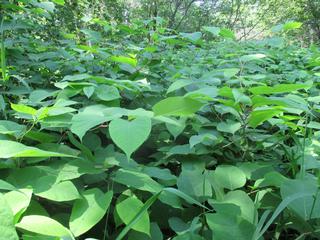
In Duluth, this isn’t our reality but we are poised to suffer an explosion of Japanese Knotweed (Polygonum cuspidatum.) This plant is commonly called “Bamboo” (although a member of the buckwheat family) because it has thick, cane like structures similar to bamboo.
Once established, Bamboo patches are very difficult to control. This perennial dies back to the ground each year, and then grows to heights of ten feet or more, often growing several inches in height per day. Simply cutting the plant encourages its long, stout rhizomes to grow, colonizing even more areas. Its seeds are wind dispersed and are quite viable.
Any type of manual control of this plant requires diligence. Covering a small patch with black plastic may still have growth near edges. Burning does not seem to control this plant. Controlling new patches that are small or in sensitive areas by grubbing out and pulling all rhizomes can be effective, but not practical on larger patches. Cutting plants every two-three weeks may also weaken and control the plant.
Chemical treatments are necessary to control larger patches. The City of Duluth is advocating the cut stem method of treatment. Cut the live stem about two inches (between stem nodes) above ground level and immediately apply a 25% solution of Glyphosate. Re-treatment may be necessary until the plant is sufficiently weakened.
To learn more, the City of Duluth is hosting the first of its educational and removal workshops.
· Thursday, July 18, 5:30-7 pm. Meet at the Irving Community Center at the corner of 57th Ave W and Main Street. Removal will happen along Keene Creek.
· Tuesday, July 23, 5:30-7 pm. Meet at the corner of Chester Park Drive and E 9th Street (near the bridge at N 15th Ave E). Removal will happen on Chester Park Drive.
For more information about Bamboo, the workshops, or, to report a location of Bamboo near you, please contact Judy Gibbs, jgibbs@duluthmn.gov or 218-730-4308.
Useful links: http://efotg.sc.egov.usda.gov/references/public/MN/797JapaneseKnotweed.pdf and http://www.dnr.state.mn.us/invasives/terrestrialplants/herbaceous/japaneseknotweed.html
# # #